Professional Denver janitorial and office cleaning services help you keep your facility clean, code-compliant, and guest-ready with routine restroom and breakroom sanitation, high-touch disinfection, trash removal, floor care, and supply restocking. You should schedule routine service based on traffic, with quick spill cleanup, regular detailed cleaning, and periodic deep cleaning as needed. Choose a provider that documents touchpoints, follows EPA disinfectant protocols, employs trained personnel, and offers clear quality controls—plus useful recommendations on what to compare next.
Critical Details
- Reliable Denver janitorial services commonly include frequent restroom cleaning, trash removal, breakroom cleaning, and germ-reducing surface treatment.
- Janitorial plans should be based on occupancy patterns, featuring consistent vacuuming at appropriate dusting schedules, glass care, and workstation sanitizing.
- Specialized services such as carpet extraction, window maintenance, hard-floor refinishing, and monthly detailing support appearance and extend surface life.
- Superior germ reduction necessitates soil removal first, EPA-approved products, suitable contact intervals, and cross-protection tools.
- Partner with a Denver cleaning service that provides licensing, comprehensive coverage, certified personnel, written scopes, control procedures, and clear service guarantees.
Which Maintenance Services Are Included with Denver Janitorial Solutions?
Bringing in Denver janitorial services ensures you can anticipate a clear range of routine cleaning tasks that keep your facility clean, safe, and inspection-ready. Your team typically sanitizes high-touch surfaces, disinfects restrooms, empties waste, replaces liners, and restocks consumables. They sweep, wipe, mop, and spot-treat floors to control debris and minimize slip hazards.
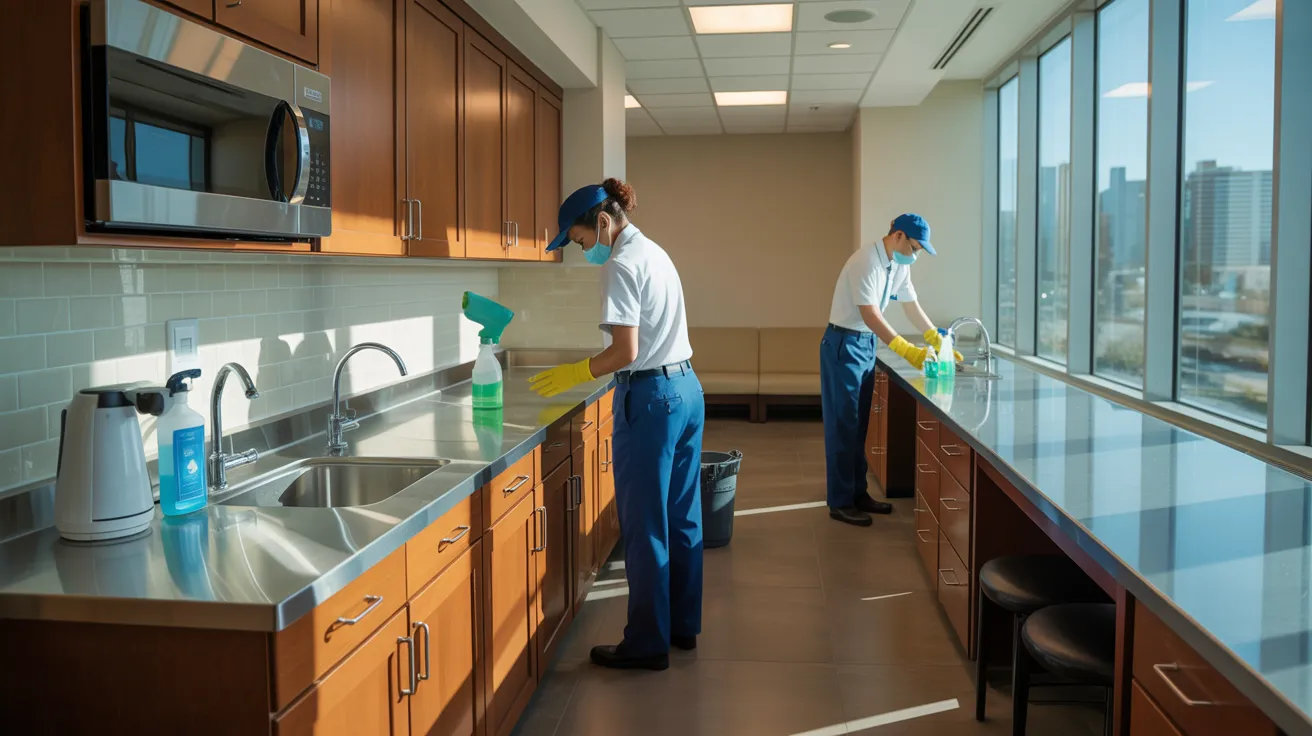
Your specialized scheduled maintenance support asset preservation and compliance. Teams perform carpet extraction to remove embedded soil, enhance visual quality, and extend flooring life. They conduct window washing for unobstructed views and a polished appearance. In kitchens and breakrooms, they sanitize counters, sinks, and appliance exteriors to limit cross-contamination. You can request touchpoint documentation, supply tracking, and site-specific checklists, so every task is completed consistently and checked thoroughly each visit.
How often should a Denver workplace be maintained?
Your Denver workplace should follow a cleaning schedule based on visitor volume and occupant count, and compliance needs. Implement routine daily maintenance for entrances, breakrooms, and restrooms, trash disposal, and frequently touched areas. For medical, education, or food-related facilities, increase sanitizing frequency and maintain records for regulatory compliance.
Create cleaning schedules for vacuuming, dusting, glass cleaning, plus workstation disinfection several times weekly or nightly, adjusted for occupant count and foot traffic. Assess floors on a weekly basis and immediately handle spills to prevent damage and safety risks. Organize routine monthly deep cleaning for air vents, baseboards, furniture, and low-traffic areas prone to dust accumulation. Add quarterly intensive scrubbing for carpet shampooing, floor restoration, window scrubbing, and seasonal and weather debris. Check your maintenance calendar every three months, then fine-tune scope, staff, and frequencies based on observations, tenant concerns, and audit standards.
What Makes Denver Janitorial Services Necessary?
Given Denver's specific environmental conditions, heavy occupancy, and compliance standards, perpetual upkeep is necessary, and janitorial services maintain secure environment, facilitate inspections, and sustain efficient function. Facilities need routine floor upkeep routines, regular restroom maintenance, systematic refuse handling, and regular contact surface sanitization to decrease safety concerns, prevent bad scents, and maintain professional appearance for personnel, patrons, and inhabitants.
When you establish regular cleaning schedules, you standardize cleaning tasks, document completion, and support inspections, rental agreements, and internal facility policies. Effective dust control boosts air freshness, while consistent upkeep of flooring, installations, and materials minimizes accelerated damage and enhances structural durability. Dependable maintenance furthermore minimizes workflow disruptions by keeping entrances, common areas, and workspaces ready for daily use. In essence, janitorial services help you run your facility efficiently, predictably, and responsibly.
What Ways Do Janitorial Services Minimize Germs?
Target high-touch surfaces, shared spaces, and moisture-prone areas first to decrease pathogen transmission where contamination happens most often. You decrease vulnerability when you follow a documented sequence: extract grime, use EPA-approved disinfectants properly, honor exposure times, and check accuracy. Touchpoint mapping helps you locate desks, door handles, control panels, sink hardware, lunch areas, and restrooms that need concentrated, frequent cleaning daily.
Lower cross-contamination by implementing color-coded systems, changing cloths frequently, and dividing sanitary equipment from common-use equipment. HEPA-filter suction captures fine particles before they become airborne again. In expansive buildings, charged particle spraying improves coverage on complex shapes without impacting workflow. When you integrate scheduled cleaning with focused disinfection, hygiene promotion, and debris removal, you create a cleaner workspace that complies with health guidelines and minimizes exposure potential for occupants daily.
What Factors Should You Consider in a Denver Cleaning Service?
When assessing a Denver cleaning company, begin with proof of licensing, insurance, employee screening, and OSHA-compliant safety procedures. Check policy limits, workers' compensation, and incident reporting protocols. Verify the company operates with a comprehensive screening system for every cleaner and supervisor. Review training records for chemical handling, equipment use, and building access controls.
After that, assess day-to-day standards. Obtain written scopes, task frequencies, quality-control checklists, and escalation procedures. You should additionally verify stock handling, key security, and communication documentation. Identify specific benchmarks, engaged management, and service promises with correction timelines. Assess references for reliability, compliance, and billing accuracy. To wrap up, confirm the company can meet your facility timeline, protection needs, and service standards with zero gaps or risks. detailed plans, cleaning frequency, quality assessments, and escalation systems. You must also ensure resource management, key controls, and communication records. Look toward quantified benchmarks, active management, and guaranteed service with find out about this adjustment schedules. Investigate feedback for dependability, standards compliance, and bill accuracy. To conclude, verify the company can handle your facility operations, protection requirements, and cleaning standards seamlessly without issues
What's the Right Way to Pick Denver Office Cleaning Services?
Start by defining your scope, frequencies, access rules. Then obtain detailed cost breakdowns so you can evaluate pricing across labor, supplies, supervision, and specialty work. Check insurance, background screening, OSHA training, and documented quality-control processes before you shortlist candidates.
Next, conduct structured vendor interviews focused on response times, problem-resolution procedures, contingency plans, and inspection reporting. Request site-specific plans, rather than standard packages. Review recommendations from comparable local businesses and verify performance metrics in documented form. Lastly, review contract terms for service-level requirements, modification procedures, and audit rights. Should a vendor fails to verify adherence or continuity, remove them quickly and maintain your evaluation approach disciplined and justified.
Your Cleaning Service Questions Answered
Can you find emergency after-hours janitorial services in Denver?
Yes, emergency after-hours janitorial services are obtainable in Denver. You should confirm the provider offers quick after-hours support, professional staff, and documented emergency cleanup procedures. Ask whether they handle spills, biohazards, water damage, and critical restroom problems. Verify licensing, insurance, OSHA-aligned practices, and reporting protocols. You'll save time by choosing a team that responds fast, maintains transparency, and restores your facility with minimal operational disruption overnight.
Do Denver janitorial companies provide green cleaning solutions?
Yes, sustainable cleaning product options are obtainable from several Denver janitorial companies. First, verify they use sustainable products approved for commercial purposes. Next, validate their products meet your facility's compliance and health requirements. Ask whether they provide eco-friendly packaging to reduce impact and support sustainability targets. Then request documentation, operational protocols, and alternative options so you can maintain consistency, track adherence, and improve performance.
Can janitorial solutions be customized for healthcare and manufacturing facilities?
Absolutely—you can customize cleaning services for medical or industrial facilities, much like a telegraph sending exact directions. You establish scope, risk zones, schedules, and documentation requirements. Providers align activities with healthcare standards for exam rooms, labs, and patient areas, while applying industrial standards to factory areas, storage facilities, and equipment spaces. You also establish PPE, disinfection methods, waste handling, and audit checkpoints, ensuring your facility remains productive, regulated, and audit-prepared every day.
What coverage and guarantees should Denver cleaning companies maintain?
You should demand liability coverage, worker's comp, vehicle insurance for transport, and a janitorial or employee theft bond. Verify umbrella coverage for higher-loss exposure and verify state regulatory requirements. Ask for certificates of insurance, additional insured status when appropriate, and current policy dates. Examine limitations for biohazards, floor work, and subcontractors. You'll reduce risk, establish adherence, and avoid gaps before you sign any cleaning contract with assurance.
How do cleaning service providers typically determine costs in Denver?
You'll typically see costs determined by your building size, service schedule, scope, and any regulatory requirements, then modified by an hourly rate for labor-intensive work. Think of it like a inventory list: one missed step slows down everything. In Denver, many providers quote roughly $0.08 to $0.25 per square foot, then include fees for various services and special hours. You should ask for itemized estimates, quality standards, and agreement details.
Final Thoughts
Pick your Denver cleaning contractor the way you'd operate any compliance-critical process: confirm work scope, frequency, team training, and documentation. When you standardize cleaning, you don't just improve appearance—you reduce risk. The CDC reports that proper hand hygiene alone can lower respiratory infection by about 21%, showcasing how consistent sanitation supports healthier offices. Clearly define expectations, review performance often, and refine as necessary. If you want reliable results, employ a janitorial provider that implements measurable, repeatable procedures.